The Dressing Table Before the Vanity Mirror
Learn how to read a dressing table before the vanity mirror through its drawers, fittings and room placement, without treating one clue as proof.
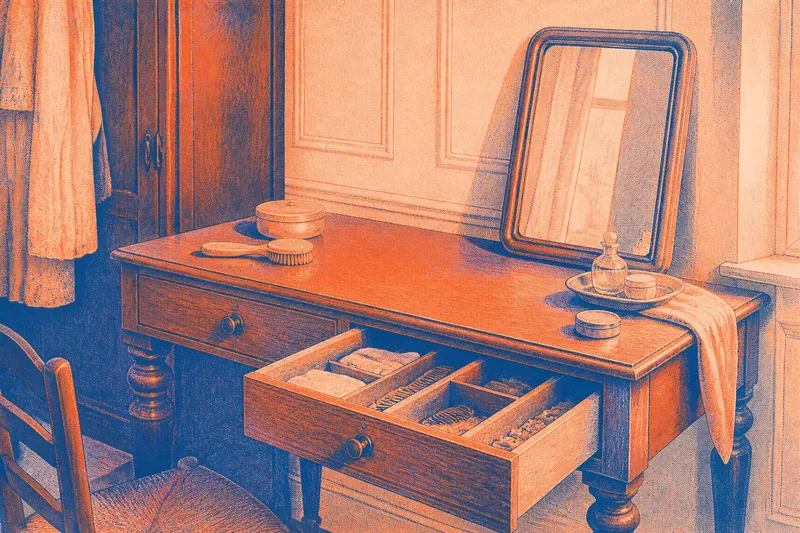
What can you tell from a dressing table before it has a built-in vanity mirror? The dressing table before the vanity mirror is best understood through the evidence on the piece itself: its surface, storage, fittings and relationship to the room. Those clues can suggest how it was used, but they cannot establish a precise history without reliable information about its date and origin.
Separate clues from claims
A dressing table may have served more than one purpose. A table that now holds a mirror and grooming objects might have been made for that role, adapted later, or moved from another room. Its appearance alone rarely settles which explanation is right.
It helps to distinguish observation from interpretation. “There is a shallow drawer beneath the top” is an observation; “it held combs” is a possible interpretation. Keep those statements separate, especially when the furniture’s provenance—the documented record of where it came from and who owned it—is unknown.
Descriptions of furniture history can easily turn plausible readings into a neat sequence of development. Without a dated, documented object or dependable historical source, avoid claiming that one form necessarily came before another. The surviving piece can still offer useful clues about its design and possible use.
Inspect the surface
Begin with the tabletop. A broad, clear surface could accommodate several activities, while a smaller area or fitted section may have been intended for a more concentrated routine. Neither shape proves a particular purpose; later owners may also have changed how a table was used.
Look for marks, fittings or changes that are visible without disturbing the object. A screw hole, an outline in the finish or an unused fitting may indicate that something was attached or removed, but it does not identify the missing item on its own. For an antique or delicate piece, leave invasive inspection and conservation to a qualified furniture conservator.
Read the storage
Drawer depth and arrangement show how the furniture divides space. Shallow drawers can keep small objects separate and close to hand; deeper ones can accommodate bulkier belongings. These are functional possibilities, not proof of what any former owner stored there.
Check whether the compartments appear original to the piece, and note locks, linings and handles. A lock suggests that someone could secure the contents, but does not establish what they were. A lining may have protected items or finished the drawer; its material and condition need careful assessment before making a more specific claim.
Consider the mirror
A mirror attached to a table makes the arrangement convenient for looking while preparing, but it does not by itself prove that the furniture was designed as a vanity. The mirror might have been added later, or the table might have been used for other tasks as well.
Look at how it is held in place. Fittings that match the table’s construction may support the idea that the mirror belongs with it, while mismatched hardware or visible alterations may suggest a later addition. Even matching details are clues rather than a definitive date or account of ownership.
Place it in the room
Where a table stands can suggest how people used it, but furniture is often moved. Beside a wardrobe, it may have connected with getting dressed; near a window, it may have benefited from available light. Those readings remain tentative unless supported by records, photographs or other reliable evidence.
For a careful description, record what is directly observable before assigning a style or function. Note the surface, drawer layout, mirror fittings and any alterations, then distinguish these details from your interpretation. If the object may be valuable or historically significant, seek an assessment from a qualified specialist rather than relying on a single decorative feature.
Which clues help most?
Was every dressing table made for grooming?
No. A table may have had several uses or been adapted by a later owner. Its layout can suggest grooming, but a documented origin is needed to support a firm account of its original purpose.
What can drawers tell you?
They show how the piece divides and provides access to storage. Their size and fittings suggest what kinds of belongings might fit, not what was definitely kept there.
Does a mirror make it a vanity?
Not on its own. Check whether its fittings appear to belong to the table and whether there is evidence of alteration, while allowing for uncertainty about when the mirror was added.
What is not worth the effort?
It is rarely useful to identify a table’s purpose from one ornament or to remove fittings in search of an answer. Record visible details and weigh several clues together instead.
Make a cautious reading
Say you are describing an inherited table with a plain top, two shallow drawers and a separate mirror resting against the wall. You first record those three visible details, then notice that the mirror has no matching attachment points on the table. The supported answer is that the table offers shallow storage and is currently used with a separate mirror; it remains uncertain whether its original purpose was grooming.
That distinction is central to reading the dressing table before the vanity mirror. Its parts can reveal how someone might have arranged personal belongings and prepared in a room, while its exact history requires evidence beyond appearance. Describe what the furniture shows, mark interpretations as possibilities, and let documented records carry claims about where and when it was made.